

INDUSTRY FOCUS
Power Generation & Electrical Systems
Overview
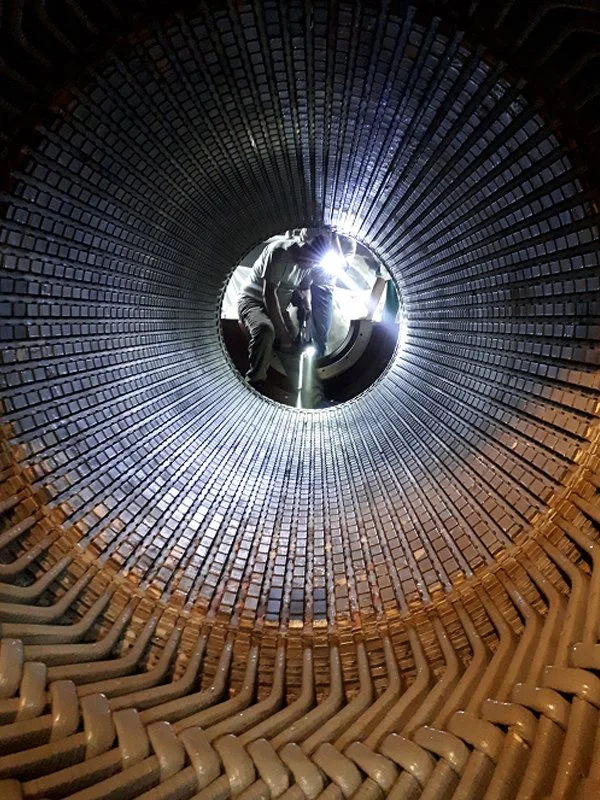
Power generation facilities operate on a simple premise: unplanned outages are unacceptable. Generator windings, stators, rotors, switchgear, and insulators continuously accumulate carbon dust, oil, grease, soot, and atmospheric dirt. Over time, this contamination forms a semi-conductive film that reduces polarisation indices, degrades insulation resistance, and creates the conditions for catastrophic flashovers.
Conventional cleaning methods introduce risks that match the problem. Solvents can dissolve critical insulation varnishes and leave toxic residues. Water washing risks short circuits, insulation degradation, and prolonged drying times that extend outage windows. Cryo Kinetic dry ice cleaning is completely dry, non-conductive, and residue-free — restoring insulation values and maximising efficiency with minimal outage time.
Why Dry Ice Is the Only Safe Option for Electrical Assets
Cleaning energised or recently de-energised electrical equipment demands a process that introduces zero moisture and zero conductive media. Standard methods simply cannot meet this requirement.
Dry ice pellets do not conduct electricity, making the process safe for direct application to windings, stators, and transformers. Because the pellets sublimate instantly on contact, no moisture enters stator slots or laminated cores — eliminating drying time entirely and allowing equipment to be re-energised immediately after cleaning. No residue. No waiting. No compromised insulation.
APPLICATIONS
Dry ice cleaning works safely across the full range of generation and electrical assets — here's how we tackle each one:
-
Carbon dust, oil, grease, and white talc film accumulate on winding surfaces, forming a semi-conductive layer that degrades insulation resistance and polarisation index readings. Non-conductive dry gas lifts carbon contamination without abrading delicate winding insulation — restoring megohm readings and polarisation index to specification without the risk that solvent or water cleaning introduces.
-
Atmospheric soot, salt scale, and coal dust accumulate on insulator surfaces and reduce electrical resistance, increasing flashover risk under load. Dry ice pellets shatter contamination scale and sublimate instantly — maximising insulator electrical resistance and eliminating the surface conductivity that precedes flashover events.
-
Carbon oil film, soot deposits, and grease accumulate on transformer core laminations and restrict heat dissipation, creating hotspot risk. Sublimation lifts grease and carbon deposits from lamination surfaces cleanly — maximising heat dissipation and reducing the risk of core hotspot failures that can take a transformer out of service permanently.
-
Carbon combustion scale and metal oxides accumulate on blade surfaces and alter aerodynamic profiles, reducing compressor efficiency and output. Thermal shock contracts scaling and peels it cleanly from blade geometry — fully restoring aerodynamic contours and compressor flow without abrasive media that would alter blade profiles.
-
Hard coal slag, fly ash, and sulfur residues build up on heat recovery steam generator tube surfaces and progressively reduce boiler thermal performance. Supersonic kinetic impact shatters dense tube scale on contact — restoring boiler efficiency without the tube erosion that abrasive hydro-blasting introduces over repeated cleaning cycles.
-
Silt deposits, algae, and river scale accumulate on turbine runner vanes and disrupt fluid dynamics, reducing generation output over time. A dry ice sweep clears debris from runner vane surfaces without introducing moisture or abrasive media — restoring turbine fluid dynamics and recovering lost generation capacity.
-
Conductive dust, light oils, and soot films on busbars and contacts create fault risk in safety-critical switching infrastructure. Dry, non-conductive dry ice media sweeps busbars and contacts clean — delivering a complete cabinet decontamination with zero operational risk of shock or moisture-induced fault.
Reducing Downtime in Energy Production
Cryo Kinetic systems reduce planned outage cleaning times by up to 65% to 80% compared to traditional hand wiping and drying methods. A turbine cleaning project that requires 120 man-hours of manual scraping can be completed by just 2 operators in 18 hours using cryogenic blasting — returning generation capacity to the grid significantly faster and avoiding the thousands of dollars per hour in lost generation revenue that extended outage windows represent.
Beyond outage reduction, regular Cryo Kinetic maintenance delivers ongoing performance benefits: improved polarisation indices, higher megohm readings, and optimised thermal dissipation across generation assets. Because the process is entirely dry, there is no need for extended "drying time" before re-energising equipment.
The cumulative effect is a meaningful reduction in the risk of catastrophic electrical failure and a measurable extension of the operating life of high-value generators, switchgear, and transformers. Our process effectively removes carbon dust, grease, and salt spray from delicate windings and insulators without the risk of abrasion or moisture-induced tracking.