

INDUSTRY FOCUS
Plastics & Composites Manufacturing
Overview
Injection moulding, compression moulding, and aerospace composite fabrication depend on clean tooling surfaces to hold tight dimensional tolerances and deliver consistent cosmetic finishes. During production, moulds accumulate polymer off-gases, release agents, cured resin buildup, and fibreglass residues. Left unchecked, these contaminants plug vents, cause non-fills, and degrade surface textures — driving scrap rates up and quality down.
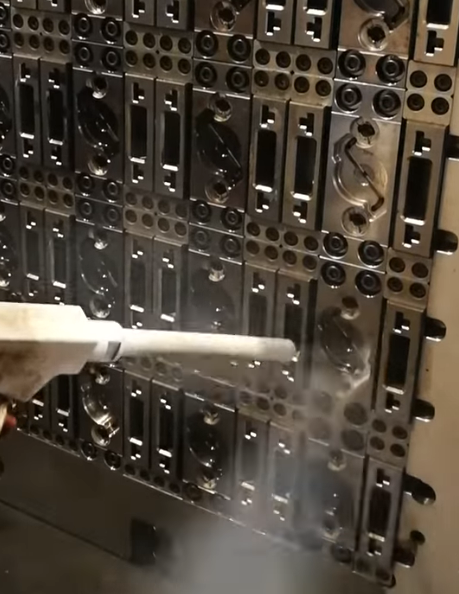
Conventional tool cleaning means cooling the press, disassembling the mould, and executing manual solvent washing or bead blasting. It's slow, disruptive, and introduces real risk of tool damage. Cryo Kinetic dry ice cleaning enables rapid, in-press tool cleaning at normal operating temperatures — no cooldown, no teardown, no production bottleneck.
Why Dry Ice Outperforms Manual Tool Cleaning
Brass brushes, scrapers, and solvents are slow and abrasive. Over time, manual scraping and grit blasting erode critical mould geometries, sharp parting lines, and delicate shutoffs — leading to part flashing, cosmetic failures, and eventually, premature tool destruction.
Cryo Kinetic technology is completely non-abrasive, protecting mirror-polished cavities, micro-textures, and tight tolerances from any surface wear. Cleaning is performed while moulds remain inside the press at normal operating temperatures, eliminating thermal cooldown and reheating cycles entirely. This also prevents the thermal stress and potential mould warping that results from the rapid temperature fluctuations associated with offline cleaning.
APPLICATIONS
Dry ice cleaning works across every tool, die, and component in your production environment — here's how we tackle each one:
-
Resin off-gases, colorants, and release agents accumulate in vents and cavities, causing cosmetic burns and non-fills. In-press blasting at operating temperature lifts residues without disturbing the mould setup — restoring full venting and eliminating defects without a single press cycle lost to cooldown.
-
Cured prepreg residues and epoxy scale on aerospace tooling cause laminate transfer defects that compromise structural integrity. Thermal shift causes epoxy to contract and peel cleanly from metal surfaces — leaving tooling pristine and ready for the next layup without surface profiling or chemical stripping.
-
Cured silicone flash and release residue accumulate in tight sealing grooves and accelerate parting line erosion. A dry ice micro-particle stream cleans these confined geometries without contact wear — extending tooling life and maintaining sealing performance between scheduled maintenance intervals.
-
SMC and BMC structural epoxy residues are among the most stubborn deposits in plastics manufacturing. High-impact kinetic energy fractures glass-fibre resins and clears heavy compression dies completely — with zero surface profiling on tooling that's expensive to repair or replace.
-
Hot polymer gels and degradation scale block extruder face holes and cause dimensional gauge shifts in the finished strand. Gas expansion sweeps die faces clean without disassembly — restoring uninterrupted plastic flow and maintaining tight output tolerances.
-
Structural flash, burrs, and moulding gates on finished parts require careful removal without surface damage. The temperature differential of dry ice freezes thin flash for clean, easy removal — delivering automated, non-abrasive deflashing with zero surface scuffing on cosmetic or functional faces.
-
Compacted off-gas waxes lodge deep in grain textures, gradually flattening leather, matte, and pattern finishes. Sublimating gas expands inside micro-textures and clears deposits from the bottom up — consistently restoring aesthetic finishes without abrading the grain detail.
Operational Advantages for Plastics & Composites
Replacing manual scrubbing with Cryo Kinetic dry ice cleaning reduces mould cleaning labour and downtime by up to 80%. Because tools are cleaned in-place at operating temperatures, facilities avoid hours of lost production waiting for moulds to cool and reheat—a hidden cost that compounds across every cleaning cycle.
Clean tooling directly reduces rejection rates and scrap while improving part cosmetic consistency and weld-line integrity. The operational life of expensive moulds and dies is extended by 3 to 5 times, because the non-abrasive process eliminates the cumulative surface wear and dimensional "rounding" caused by hand scraping, chemical baths, and grit blasting.
Because dry ice leaves zero secondary waste or media residue, production resumes immediately after cleaning—with no risk of media entrapment in ejector pins or vents. This ensures a "surgical" level of clean that maintains the high-tolerance finishes required for medical, automotive, and aerospace-grade composites.