

INDUSTRY FOCUS
Automotive Detailing, Restoration & Performance
Overview
Whether you're preparing a prestige vehicle for the showroom floor, rebuilding a performance engine for the track, or restoring a classic to its original condition, contamination is the enemy of quality work. Grease, brake dust, carbon deposits, old underseal, and decades of grime accumulate in the places that matter most — engine bays, underbodies, suspension components, and brake assemblies — and conventional cleaning methods struggle to address them without creating new problems.
Chemical degreasers leave residues that compromise paint adhesion and attack rubber seals. High-pressure water forces moisture into cavities, bearings, and electrical connectors where it causes corrosion and short circuits. Steam cleaning introduces heat and moisture into spaces where neither belongs.
Cryo Kinetic dry ice cleaning is waterless, chemical-free, and completely non-abrasive. It reaches the tight spaces and complex geometries that other methods can't — without disassembly, without residue, and without damaging the surfaces you've invested time and money to prepare.
Why Dry Ice Works Where Other Methods Fall Short
Dry ice pellets sublimate on contact, transitioning from solid to gas instantly. There's no secondary media left behind in engine internals, no moisture driven into cavities, and no chemical residue to interfere with coatings or seals. The thermal shock of the process embrittles stubborn deposits — old grease, carbon scale, underseal — allowing them to be lifted cleanly from surfaces that would be damaged by abrasive or chemical alternatives.
For auto dealers, that means vehicles presented cleaner and faster. For performance workshops, it means engines and components returned to a standard that inspires confidence. For restorers, it means original surfaces uncovered intact — without the surface profiling that sets a restoration back before it's begun.
APPLICATIONS
Dry ice cleaning works across every stage of detailing, preparation, and restoration work — here's how we tackle each application:
-
Accumulated grease, oil residue, and carbon deposits make engine bays difficult to inspect, present, or photograph — and chemical degreasers risk damaging wiring looms, rubber hoses, and painted surfaces. Dry ice cleans engine bay components in-place without moisture or chemicals, lifting grease and grime from tight spaces around sensors, cables, and ancillaries with zero risk of damage.
-
Road grime, old underseal, bitumen, and corrosion products accumulate on underbody surfaces and obscure the structural condition of chassis rails, subframes, and floor pans. Dry ice blasting strips these deposits cleanly, leaving bare metal surfaces ready for inspection, rust treatment, or fresh underseal application — with no flash rusting risk because the process introduces zero moisture.
-
Brake dust, heat scale, and corrosion accumulate on calipers, rotors, and hub faces and are difficult to remove without abrasive methods that damage machined surfaces. Dry ice micro-particles clean brake components and hub faces precisely — removing deposits without altering surface finishes or leaving residue that could contaminate brake friction surfaces.
-
Grease, road grime, and corrosion on suspension arms, knuckles, and steering components make condition assessment difficult and preparation for restoration work time-consuming. Dry ice cleaning removes accumulated contamination from complex suspension geometries without disassembly — delivering components clean enough for accurate inspection and ready for coating or rebuild.
-
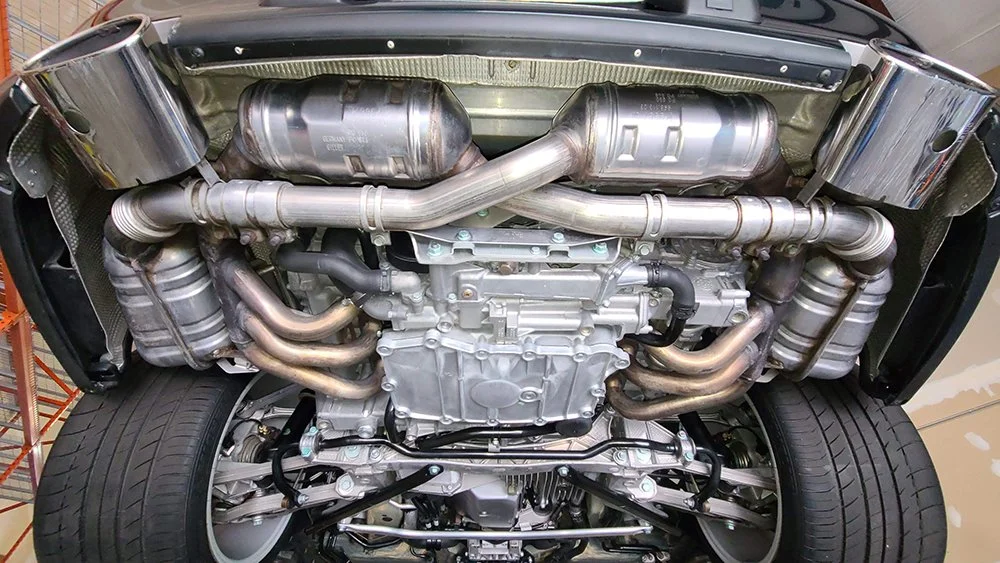
Carbon scale, heat discolouration deposits, and corrosion products on exhaust manifolds, headers, and heat shields are tenacious and difficult to remove without abrasive blasting that alters surface profiles. Thermal shock embrittles carbon scale and lifts it from exhaust components cleanly — preparing surfaces for ceramic coating or heat wrap application without profiling the underlying metal.
-
Contaminated or poorly prepared surfaces are the leading cause of paint adhesion failure and premature coating breakdown. Dry ice blasting strips release agents, old wax, surface contaminants, and deteriorated coatings from body panels — leaving a clean, dry surface ready for primer or paint application without the sanding marks or chemical residues that compromise finish quality.
-
Old grease, grime, deteriorated foam residues, and years of accumulated contamination in door cavities, sill plates, and interior structures are difficult to address without introducing moisture or chemicals into spaces that are hard to dry out. Dry ice cleaning reaches these confined areas without moisture, lifting contamination and leaving surfaces dry and ready for restoration work.
Operational Benefits for Dealers & Workshops
For auto dealers, dry ice cleaning compresses vehicle preparation time significantly — engine bays, underbodies, and wheel wells that would take hours of chemical cleaning and drying can be turned around quickly, getting vehicles onto the floor or into photography faster without compromising presentation standards.
For performance workshops, the ability to clean engines, gearboxes, and suspension components in-situ — without full disassembly — reduces labour time on preparation and allows technicians to work from a clean baseline that makes inspection and fault-finding more accurate.
For vehicle restorers, the non-abrasive process is the critical advantage. Original surfaces, stampings, date codes, and factory finishes are uncovered intact rather than eroded — preserving the originality that drives restoration value. And because there's no media residue, blast cabinets, or containment infrastructure required, the process works on the rotisserie or the hoist, wherever the vehicle sits.